


As a person conducting a business or undertaking (PCBU), you must eliminate or minimise risks in the workplace from airborne contaminants so far as is reasonably practicable. To manage risks from airborne contaminants, you should follow the risk management process:
- Identify hazards
- Assess risks
- Control risks
- Review control measures
When working through the risk management process, you must also consult with your workers. By drawing on the knowledge and experience of your workers, you can make more informed decisions about how to carry out the work safely.
1. Identify hazards
To protect workers from being harmed by hazardous substances, you must first identify if there are any airborne contaminants at your workplace.
You can identify airborne contaminants in your workplace by:
- looking at your workplace, products and processes
- talking and consulting with your workers
- reading any labels and safety data sheets
- talking with your WHS regulator
- engaging a professional such as an occupational hygienist.
2. Assess risks
Once you have identified an airborne contaminant, you need to undertake a risk assessment to consider what could happen if your workers are exposed to the hazardous substance and the likelihood of it happening. A risk assessment will help you:
- identify which workers are at risk of exposure
- determine what sources and processes are causing the risk
- identify if and what kind of control measures should be implemented, and
- check the effectiveness of existing control measures.
3. Control risks
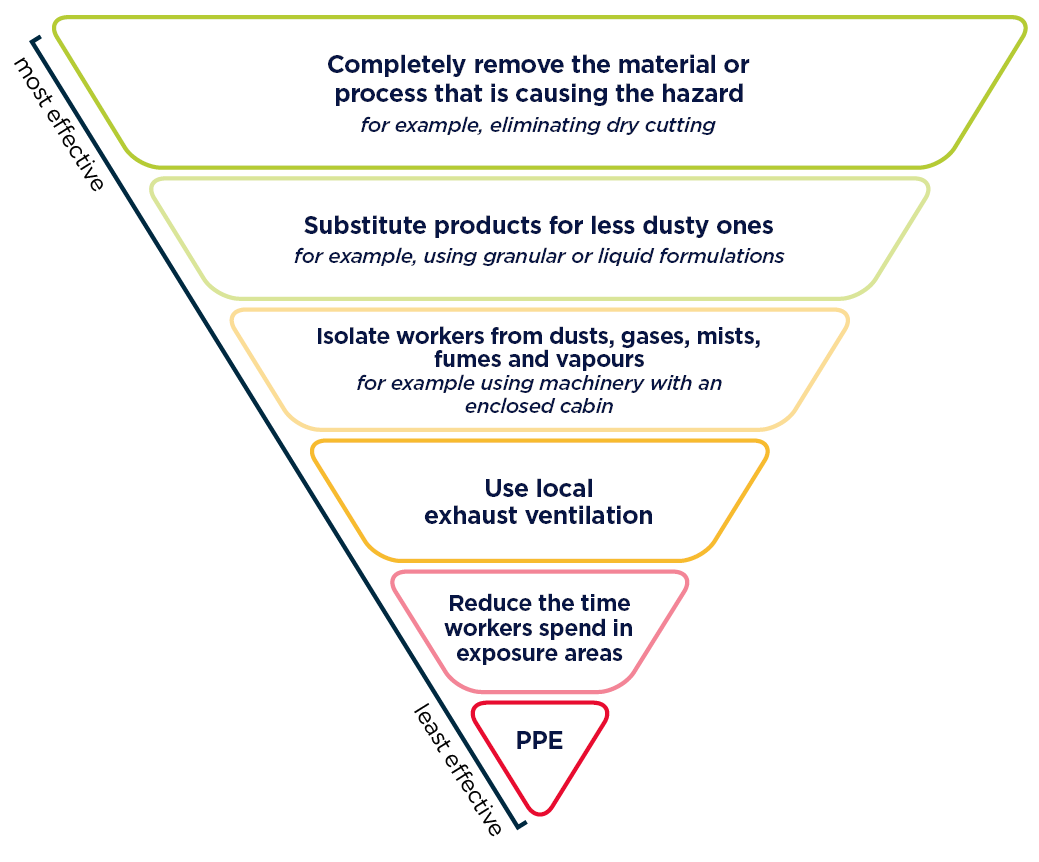
You should always aim to eliminate risks, as this is the best way to manage risks. Where this is not possible, you must minimise risks so far as is reasonably practicable.
Elimination
The most effective way to manage a risk is to completely remove the hazard from your workplace. This means eliminating the creation of hazardous dusts, gases, fumes and vapours. Examples of elimination controls can include:
- using products or materials that don’t contain the hazardous substance
- eliminating the need to undertake the task that releases the hazardous substance into the air.
In some cases, elimination might not be possible. Where this occurs, you must work through the hierarchy of risk control measures.
Examples of effective control measures for managing the risks of airborne contaminants
If you or your workers could be exposed to dusts, gases, mists, fumes or vapours, make sure you’ve implemented the right control measures.
Employers must ensure that exposure to airborne contaminants is as low as possible so workers don’t get sick.
Substitution
Substitution controls involve replacing the hazard with something safer:
e.g. using granular or liquid formulations instead of ones that produce dust.
Isolation
Isolation controls involve isolating the hazard from people:
e.g. completing the task that releases the hazardous substance in an enclosed, well-ventilated space that is separated from people.
Engineering
Engineering controls involve using a physical control measure, such as a mechanical device or process:
e.g. using dust suppression, local exhaust ventilation and on-tool dust extraction.
Administrative
If you’ve worked through the hierarchy of control measures and risk remains, you must minimise the risk by implementing administrative controls, for example:
- planning tasks to minimise the quantity of the hazardous substance being released into the air
- reducing the time workers spend in exposure areas
- establishing policies about working with the hazardous substance and clean up requirements
- installing signage alerting people of the risks involved and how to minimise them.
Personal protective equipment
Personal protective equipment (PPE), including respiratory protective equipment (such as masks), is one of the least effective control measures because it does not control the risk at the source. PPE should only be considered after implementing substitution, isolation, engineering, and administrative controls. You should use PPE to supplement higher-level control measures.
In some situations, higher-order control measures might not control the risk fully. In these cases, PPE must also be used.
4. Review control measures
Implementing measures for controlling airborne contaminants isn't a matter of simply "set and forget". You must regularly monitor and review your control measures to make sure they are still effective and are working as intended. If you’ve implemented measures to control dusts, gases, fumes, mists or vapours, you must review them:
- when the control measure is not effective in controlling the risk
- before a change at your workplace that is likely to give rise to a new or different health and safety risk that the control measure may not effectively control
- if a new hazard or risk is identified
- if the results of consultation indicate that a review is necessary, or
- if a health and safety representative requests a review.
After you review your control measures, if you have identified a new or changed hazard or risk that needs to be addressed, you should:
- go back through the risk assessment steps (identify and assess hazards, eliminate and control risks and monitor and review controls)
- consult with your workers, and
- implement new control measures to address the new or changed hazard or risk that you’ve identified.