


SafeWork SA has developed resources to help employers and workers manage the risks associated with working in hot conditions. SafeWork SA is currently updating these resources.
Jump to:
- Stopping work due to heat
- Employer responsibilities
- Worker responsibilities
- Heat illnesses
- Ultraviolet radiation
- NEW - Additional resources
With South Australian summers being well known for their extreme heat and dryness and damaging levels of ultraviolet radiation for most of the year, we remind employers of their responsibility to manage risks associated with heat stress and overexposure to UV radiation.
Australia has some of the highest rates of skin cancer in the world. It is a largely preventable disease yet, two in every three Australians will develop skin cancer by the age of 70. Each year in Australia around 200 melanomas and 34,000 non melanoma skin cancers (nmsc) are due to occupational ultraviolet radiation (UVR) exposure.
Duty holders, principal contractors, builders, labour hire agencies and employers must identify and control solar UV radiation exposure risks and heat related hazards, so far as reasonably practicable.
Duty holders should consult, coordinate, and cooperate with each other to minimise the risk of thermally stressful situations and the risk of overexposure to UV radiation to workers, through a risk management approach.
Stopping work due to heat
The work health and safety legislation does not specify a ‘stop work’ temperature. A single ‘stop work’ temperature would not capture the range of factors that make working in the heat hazardous, such as humidity, air flow, the source of the heat (internal or external), the physical intensity and duration of the work, individual factors of workers (eg physical fitness and acclimatisation), and if controls can be implemented (eg providing access to shade and/or air conditioning).
In some workplaces, a ‘heat clause’ is included in employment agreements, however risks associated with heat still need to be managed so far as is reasonably practicable by the person conducting a business or undertaking (PCBU)
See our Guidance for working in heat (external site) (external site) (external site) (external site) (external site) for further details.
Employer responsibilities
Employers have a duty of care to ensure they are not putting their workers’ health and safety at risk. Employers should be familiar with the Managing the Work Environment and Facilities - Code of Practice.
Unless it is specified in workplace employment agreements, the work health and safety legislation does not set temperatures at which a worker may be sent home, nor does it determine acceptable levels of ultraviolet radiation (UVR) exposure. Each workplace environment is different, and the onus is on the employer to manage any risks, in consultation with their workers. If it is not possible to eliminate exposure to UVR or increased temperature, the risk of skin damage and heat-related illness must be minimised so far as is reasonably practicable.
Managing the risks
The following steps should be used, so far as is reasonably practicable, to ensure that workers and other people are not exposed to harm from working in the heat.
A PCBU must consult workers and their HSRs (if any) when deciding how to manage the risks of working in the heat. If there is more than one business or undertaking at the workplace, the PCBU must consult each one to find out who is doing what, and work together to eliminate or minimise risks, so far as is reasonably practicable.
Identify the hazard
Heat is a hazard in many Australian workplaces, whether work is performed indoors or outdoors.
To find out if it is a hazard in the workplace, a PCBU needs to consider:
- air temperature
- air flow
- humidity
- radiant heat sources
- work requirements
- the workers, including the attributes and the needs of individual workers
- the workplace.
A workplace may be susceptible to heat-related problems if the answer to one or more of the following questions is ‘yes’:
- Has anyone ever been affected by heat in the workplace?
- Can workers be exposed to temperatures that exceed 30°C and/or high humidity?
- Does a ‘wet bulb’ temperature reading need to be taken to adequately identify the hazard?
- Is there any plant or equipment that produces heat or steam?
- Do any work processes make the surroundings hotter?
- Are there any areas of the workplace that are particularly hot?
- Are there surfaces or equipment that produce, radiate, or reflect heat and/or ultraviolet radiation (UVR)?
- Do workers wear protective clothing and/or PPE that can make them hot?
- Are workers engaged in physical tasks (including prolonged standing)?
- Are any work areas poorly ventilated with little airflow?
- Can hot air build up in the workplace over successive hot days?
- Are there any barriers or structures within the workplace that prevent the crossflow of air?
- Can it ever be hotter inside the workplace than it is outside?
- Can it ever be more humid inside the workplace than it is outside?
- Are any non-insulated walls or ceiling spaces of the workplace exposed to direct sunlight?
- Are workers working outdoors when the ultraviolet (UV) index is 3 or above?
Assess the risk
A risk assessment will assist the PCBU to determine:
- how severe the risk is
- whether existing control measures are effective
- what action the PCBU should take to control the risk
- how urgently the PCBU needs to act.
A three-stage approach to risk assessment
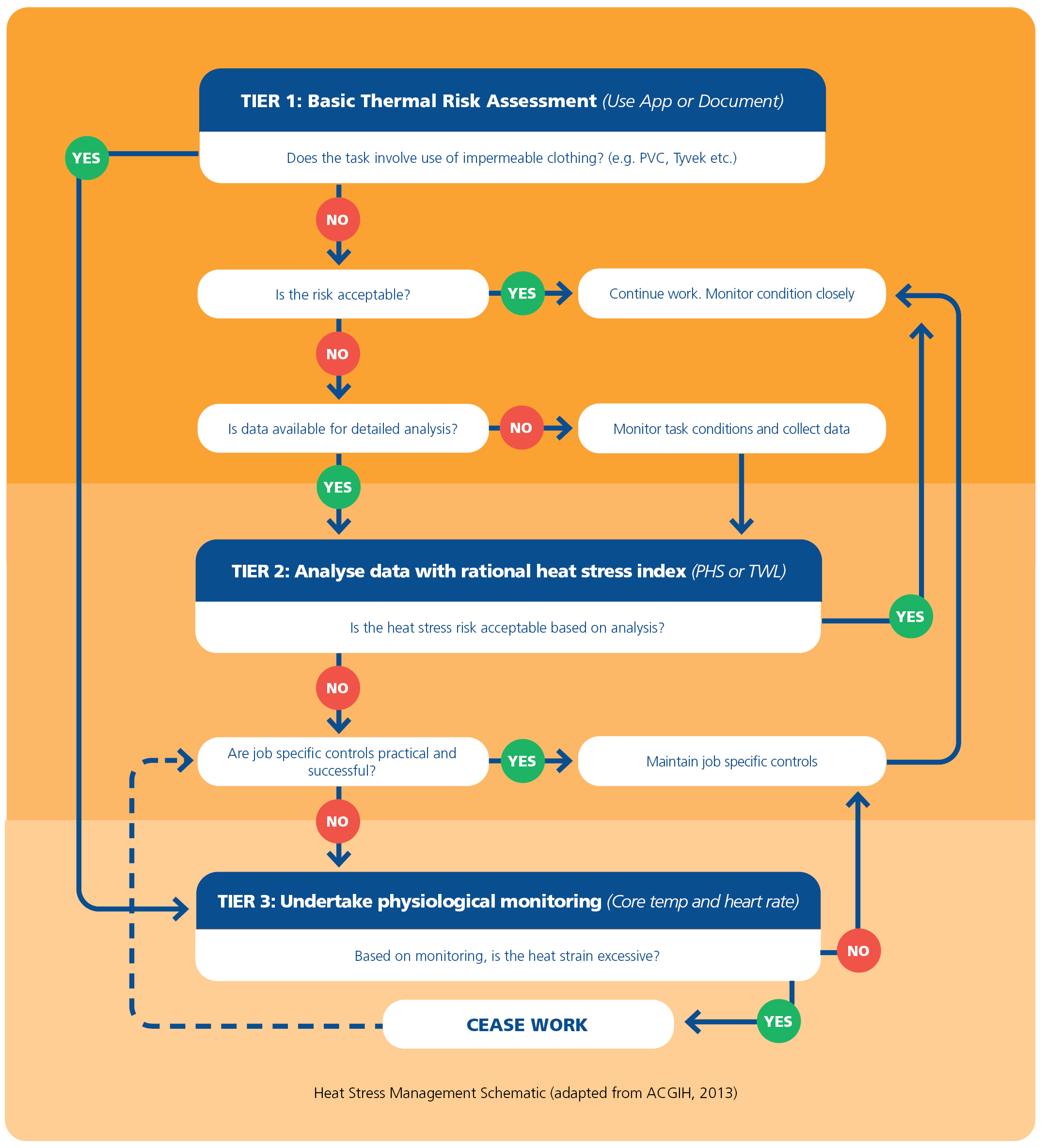
The Australian Institute of Occupational Hygienists, Australia’s peak professional body for the evaluation and monitoring of occupational exposures, recommends a three-stage approach to risk assessment which is dependent on the level of risk encountered.
The diagram below represents the three different tiers of assessment and the decision-making to determine when a higher level of assessment is required. It is important to remember that the differing tiers of risk assessment require increasing levels of technical expertise and skill of the assessor.
Tier 1 – Basic thermal risk assessment
The basic thermal risk assessment is designed as a qualitative tool to help frontline workers understand thermal stress without needing technical expertise. The assessor rates various task and environmental factors using a simple check sheet, highlighting the multiple aspects of the work environment that affect thermal stress, not just the dry temperature. It is not intended as a definitive assessment tool.
The parameters include assessment of:
- air temperature
- relative humidity
- type of clothing worn by a worker
- sun exposure
- hot surfaces
- exposure period
- enclosed spaces
- task complexity
- climbing
- distance from a cool rest area
- distance from drinking water
- understanding of heat strain risk
- wind speed
- respiratory protective equipment
- metabolic work rate
- acclimatisation.
A PCBU can use the Heat Stress Calculator (external site) (external site) (external site) (external site) (external site) (external site) (external site) (external site), developed by Workplace Health and Safety Queensland, and based on the Australian Institute of Occupational Hygienists’ basic thermal risk assessment tool.
Tier 2 – Heat stress index assessment
The heat stress index is used to determine the projected level of impact on the work group or
individual worker. It can produce a predicted heat strain (PHS), core body temperature, or thermal work limit (TWL), which can then be used to determine allowable exposure times for individuals or groups. 12 This tool should be used if the initial (tier 1) assessment indicates an unacceptable risk. It involves the quantitative evaluation of thermal stress, and the key measurements include:
- environmental: air temperature, globe temperature, relative humidity, air speed
- personal: metabolic workload/posture, clothing insulation
- duration of exposure.
A tier 3 (expert) assessment will be needed when either:
- data cannot be collected
- where impermeable clothing is worn by a worker.
Tier 3 – Physiological monitoring
This assessment method focuses on direct measurement of individual physiological strain under thermal stress. It accounts for individual variables like age, fitness, hydration, and health. It tracks real time physiological responses such as heart rate, core temperature, sweat rate, and evaluates actual impact rather than predicted or averaged outcomes.
This assessment delivers results that can be used with greater confidence in relation to how thermal stress affects a specific person, which can in turn be used to implement exposure limits and safety protocols. It explicitly includes the thermal burden of personal protective equipment, which can significantly alter heat strain. Physiological monitoring should be supervised by an appropriately experienced medical practitioner.
This level is recommended for high-risk environments where the use of a rational heat stress index (PHS or TWL) results in an allowable exposure time of less than 30 minutes, or there is a high level of specialised PPE used such as fully reflective clothing or impermeable coveralls, and individual tolerance varies widely. These settings include firefighting, mining, or some industrial environments.
Control the risk
Some practical suggestions for employers to minimise these risks include: | Risk control for heat | Risk control for UV |
| Yes | |
| Yes | Yes |
| Yes | Yes |
| Yes | Yes |
| Yes | |
| Yes | Yes |
| Yes | Yes |
| Yes | |
| Yes | Yes |
| Yes | |
| Yes | |
| Yes | |
| Yes | Yes |
| Yes | Yes |
See Safe Work Australia's resources below, for more information:
- Managing the risks of working in heat fact sheet (external site) (external site) (external site) (external site) (external site) (external site) (external site) (external site)
- Checklist for risk-managing heat in the workplace (external site) (external site) (external site) (external site) (external site) (external site) (external site) (external site)
- Guide for managing the risks of working in heat (external site) (external site) (external site) (external site) (external site) (external site) (external site) (external site)
- Managing the risks of solar ultraviolet radiation fact sheet (external site) (external site) (external site) (external site) (external site) (external site) (external site) (external site)
- Guide on exposure to solar ultraviolet radiation (external site) (external site) (external site) (external site) (external site) (external site) (external site) (external site)
- Model Code of Practice: How to manage work health and safety risks (external site) (external site) (external site) (external site) (external site) (external site) (external site) (external site)
Worker responsibilities
Unless it is specified in workplace employment agreements, the work health and safety legislation does not set temperatures at which a worker may be sent home, nor does it determine acceptable levels of ultraviolet radiation (UVR) exposure. Each workplace environment is different, and the onus is on the employer to manage any risks, in consultation with their workers.
Workers have a responsibility to contribute to the management of risks and to take care of their own health and should: | Risk control for heat | Risk control for UV |
| Yes | Yes |
| Yes | |
| Yes | |
| Yes | |
| Yes | |
| Yes | |
| Yes | Yes |
Visit the following websites for more information:
- Working in heat: physically demanding work (external site) (external site) (external site) (external site) (external site) (external site) (external site) (external site). (YouTube clip)
- sunsmart.org.au (external site) (external site) (external site) (external site) (external site) (external site) (external site) (external site)
Heat illnesses
Know the warning signs
View our warning signs infographic to easily identify symptoms of heat illnesses.
Contributing factors
Heat-related illness is very serious and can be fatal, but most importantly, is preventable. Heat illnesses occur when your body absorbs more heat from your environment than you can physically get rid of through perspiration or other cooling mechanisms. Some reasons why workers may experience heat-related illness are:
- if they are exposed to direct sunlight, especially during the hottest parts of the day with no shade relief
- if they are carrying out strenuous tasks or work for sustained long periods in hot conditions
- if they are exposed to reflected heat from construction materials, polished aluminium and glass, or heat build-up in roads and concrete structures
- if they are exposed to additional heat (from machinery).
Other factors that may contribute to heat-related problems at work include:
- inadequate cooling off or rest periods and insufficient water consumption
- climatic conditions (low air movement, high humidity, high air temperature and high radiant heat)
- inappropriate clothing (non-breathable materials)
- individual medication that may affect the body’s temperature regulation
- things that may cause dehydration such as poor diet, vomiting, diarrhoea or excessive alcohol and caffeine consumption
- individual medical conditions such as heart problems, diabetes and hypertension
- increasing age, poor general physical fitness or being overweight
- new workers that are not acclimatised or young workers who underestimate risks
- workers not recognising symptoms of heat related illness.
There are a range of medical conditions that can arise when the body is unable to cope properly with working in the heat. Heat illness can occur if the worker starts:
- vomiting or feels nauseous
- feeling dizzy or weak
- feeling clumsy, light headed and/or faints.
Heat stroke
Heat stroke is perhaps the most serious temperature-related illness as it is life-threatening and requires immediate first aid and medical attention. Signs and symptoms to look out for include:
- a high body temperature of 40°C
- flushed and dry skin
- a pounding, rapid pulse.
Heat stress
Heat stress can be caused by physical exertion outdoors in hot weather or by working in hot and cramped work areas that have poor ventilation.
Symptoms to be on the lookout include:
- pale, cool, clammy skin
- rapid breathing and shortness of breath
- a rapid or weak pulse.
Heat discomfort
The more common outcome of living in a hot country like Australia is to experience heat discomfort. This is what many people feel when it is hot, although, unlike heat illness and stroke, it is not a medical condition and isn’t considered a risk to health.
Those who work in office-type environments or do minimal physical work are unlikely to suffer from a heat illness. What they experience as a result of higher temperature and increased humidity is most likely heat discomfort.
There are several simple solutions that office environments and other indoor areas can do to properly manage heat discomfort such as:
- increasing air movement
- providing access to cool water
- providing air conditioning (if practical)
- wearing suitable light and loose fitting clothing.
The following general conditions are considered to be comfortable for people working indoors and doing light work and include:
- keeping the air temperature between 23°C and 26°C
- maintaining a relative humidity of 30 to 60 percent.
Plan ahead and ensure all necessary measures for preventing heat illnesses can be implemented when hot weather is predicted. Doing so will ensure the safety and well-being of your workers.
See Safe Work Australia's First aid for heat-related illness (external site) (external site) (external site) (external site) (external site) (external site) (external site) (external site) for further information.
Ultraviolet radiation
Our sun emits different kinds of energy as part of the electromagnetic spectrum (external site) (external site) (external site) (external site) (external site) (external site) (external site) (external site), which includes:
- infrared radiation that we can feel (heat or temperature);
- visible light that we can see (sunlight);
- and ultraviolet (UV) radiation (that can’t be seen or felt).
UV radiation is responsible for causing skin damage, premature ageing and skin cancer and because UV is invisible to our senses, we cannot rely on them to determine the need for sun protection.
All skin tones can be damaged by overexposure to UV radiation and this damage is permanent, irreversible and increases with each exposure, across our lifetime. Almost all skin cancers (approximately 99% of non-melanoma skin cancers and 95% of melanoma) are caused by overexposure to UV radiation.
People who spend all or part of the day regularly working outdoors are at increased risk of skin cancer Outdoor workers receive up to 10 times more solar UV exposure than those who work indoors. Every year in Australia, it’s estimated that over 200 melanomas and 34,000 other skin cancers are caused by UV damage in the workplace.
Unlike managing the risks of heat stress, preventing UVR damage encompasses year-round protection. Due to the extended periods of exposure that outdoor workers experience, even when UVR levels are low (such as during the winter months) damage still occurs and year-round sun protection is therefore necessary.
Assessing the risk
Exposure to solar UV radiation is a risk for anyone who works outside, not only from direct sunlight but also from the surrounding environment as UV radiation can be reflected off certain materials, such as concrete, metal, sand and water, therefore increasing the overall level of exposure.
Undertake a periodic risk assessment to identify workers who have a high risk of exposure to UV radiation and situations or work systems where high exposure to UV radiation occurs. Factors which influence the total exposure to UV radiation include:
- the geographical location of the work
- the time of year when outdoor work occurs
- the times of the day when outdoor work occurs
- the pattern and length of exposure - exposure can occur in an ongoing episode or via a series of shorter episodes which accumulate over time
- the availability and use of control measures
- the presence of reflective surfaces, and
- the presence of photosensitisers.
Photosensitivity can be caused by ingesting, inhaling or coming into skin contact with a range of substances including some industrial chemicals, plants and medication. More information on substances which cause photosensitivity can be found on page 7 of the ‘Guide on exposure to solar ultraviolet radiation (external site) (external site) (external site) (external site) (external site) (external site) (external site) (external site)’ available from Safe Work Australia www.safeworkaustralia.gov.au (external site) (external site) (external site) (external site) (external site) (external site) (external site) (external site).
Use the hierarchy of risk control to identify suitable control measures that eliminate or minimise the risk as far as reasonably practicable.
Managing the risk of overexposure to UV
Solar UV radiation must be managed throughout the year by implementing a combination of the following control measures:
- Elimination
- Where possible, move tasks indoors to remove the UVR hazard to a worker.
- Where possible, rotate jobs between workers if some activities can be done in shaded areas/ indoors, so no one worker is outdoors for extended periods.
- Engineering controls
- Provide shaded areas or temporary shade for stationary tasks and breaks and encourage their use. Additional UV protection is still recommended even if working in shaded areas outdoors.
- Where possible, change, modify or avoid reflective surfaces. Soft or rough surfaces reflect less UVR and are safer than hard or smooth surfaces. Painting surfaces a less reflective colour (dark colours) also helps to reduce reflective UVR.
- Consider applying window tinting to work vehicles or plant equipment to help reduce the amount of solar UVR entering the vehicle.
- Identify and minimise contact with photosensitising substances.
- Administrative controls
- Plan work routines so outdoor tasks are done early in the morning or later in the afternoon when UV levels are lower.
- Provide training and education to workers about working safely in the sun.
- Announce or display the daily UV Index and sun protection times in a common area or encourage workers to use the SunSmart Global UV app via their smartphones.
- Provide workers with information on why and how to check their skin, and reminded to do so regularly. High-risk workers should be encouraged consult their GP.
- Personal protective equipment (PPE) - ensure outdoor workers are protected in as many ways as possible including:
- Uniform that covers as much skin as possible, including long-sleeved shirts with collars and long trousers. Where possible choose clothing made from material with an ultraviolet protection factor (UPF) of 50+.
- Close fitting, wraparound sunglasses that meet Australian Standards (AS/NZS 1067) or safety glasses rated “O” (AS/NZS 1337.1) that provide good UV protection
- A broad brimmed, bucket or legionnaire style hat that covers the head, face, neck and ears. Use brim or neck flap attachments where hard hats are a requirement
- Broad-spectrum, water resistant sunscreen and lip balm with a SPF 50+, that is generously applied to any remaining exposed skin, 20 minutes prior to going outside and reapplied at least every two hours.
Visit Safe Work Australia's Guide on exposure to solar ultraviolet radiation (UVR) (external site) (external site) (external site) (external site) (external site) (external site) (external site) (external site), ARPANSA’s Ultraviolet radiation monitoring (external site) (external site) (external site) (external site) (external site) (external site) (external site) (external site) or www.sunsmart.org.au (external site) (external site) (external site) (external site) (external site) (external site) (external site) (external site) for more information.
Cancer Council SA support
Cancer Council SA can assist workplaces to meet their WH&S responsibilities and duty of care through provision of education, guidance and support. Cancer Council SA can provide information and resources and to identify controls to manage UV hazards in the context of your workplace situation, review current workplace practices and develop a UV protection policy.
For more information about the SunSmart Workplace program, visit www.cancersa.org.au/prevention/workplace-risk/uv-radiation (external site) (external site) (external site) (external site) (external site) (external site) (external site) (external site) or email prevention@cancersa.org.au.
Additional resources
- Webinar: Managing the risk of heat stress and UV in the workplace (external site) (external site)
- Guidance for working in the heat
- Working in the heat factsheet (external site) (PDF) (external site) (PDF) (PDF)
- Working in heat - Safe Work Australia (external site) (external site) (external site) (external site) (external site) (external site) (external site) (external site)
- Working in the sun - Safe Work Australia (external site) (external site) (external site) (external site) (external site) (external site) (external site) (external site)
- UV and sun protection in the workplace (external site) (external site) (external site) (external site) (external site) (external site) (external site) (external site) - Cancer Council SA
- Heat stroke - Healthdirect (external site) (external site) (external site) (external site) (external site) (external site) (external site) (external site)
- Heat Stress Calculator (external site) (external site) (external site) (external site) (external site)
- (external site) (external site) (external site) (external site) (external site) (external site) (external site) (external site)Australian Institute of Occupational Hygienists (external site) (external site) (external site) (PDF) (external site) (PDF) (external site) (external site) (external site)Gu (external site) (external site) (external site)
(external site) (external site) (external site)