


Just like any other work environment, working in an office can expose workers to a range of psychosocial hazards such as high work demands, low role clarity, poor change management and harmful behaviours such as bullying.
The basic process of managing these and other types of psychosocial hazards is largely the same as that for physical hazards. Our step-by-step guide shows you how to do this.
In addition to following these steps, it is useful to consider some of the unique stressors experienced by office-based workers and the most effective ways to reduce them.
The unique demands of office and desk-based work
Office and desk-based work tends to be what is known as knowledge and information-based work. This kind of work is often mentally demanding. It can also entail exposure to frequent organisational change and, in some contexts, exposure to ‘emotional labour’ (such as providing support and empathy to others or working with potentially distressing material).
Examples of office-based occupations are cybersecurity and business intelligence analysts, project managers, lawyers, health and social care professionals, accountants, ICT technicians, engineers, technology developers, architects, researchers, and education professionals. These and other knowledge and information-based workers are often expected to:
- analyse large volumes of complex information
- be creative and innovative
- think critically
- work under time pressure
- adapt to change in how they work associated with global economic pressure and competition and the rapid uptake of smart technology, artificial intelligence, robotics, and algorithms (external site) in their workplaces
- be able to manage their own emotions while being exposed to other people’s emotions (while, for example, proving counselling services) or tasks of a potentially distressing nature (such as reading witness accounts of violent crimes).
While many knowledge and information-based workers enjoy its unique challenges, excessive exposure to mental and / or emotional demands and organisational change can put them at risk of potential psychological or physical harm in the form of burnout, and psychological and physical injury or illness.
What are the best ways to protect knowledge and information-based workers?
Persons conducting a business or undertaking (PCBUs) have a responsibility to take reasonable steps to mitigate the risk of harm associated with knowledge and information-based work. Below are some examples of measures that PCBUs should ideally have in place.
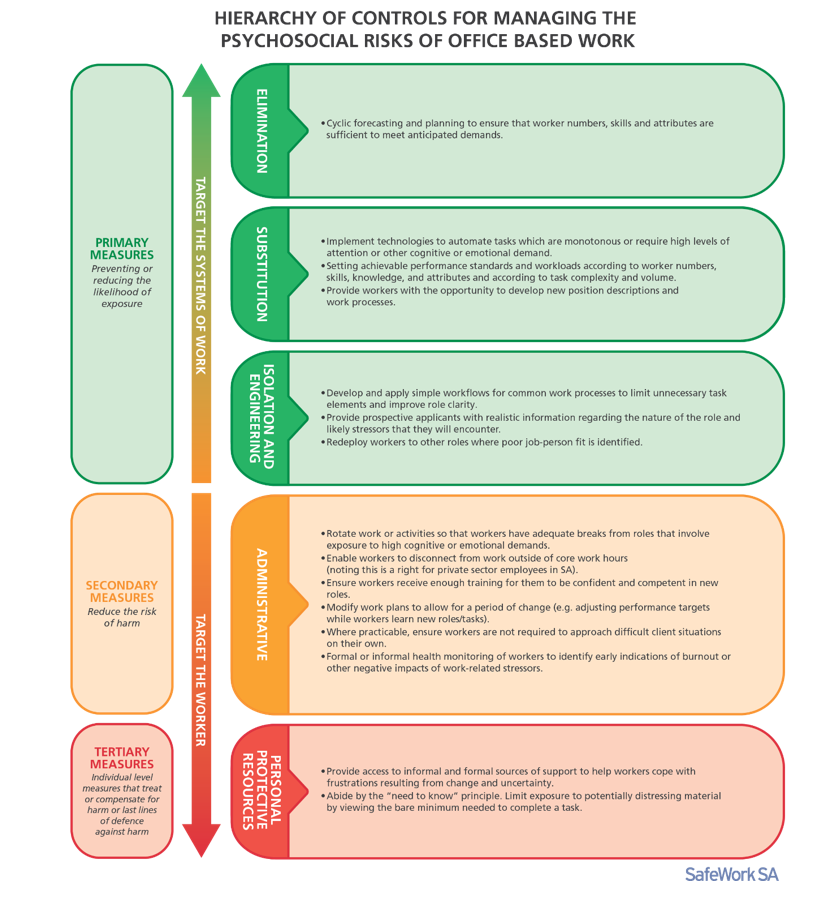
These are just a sample of ways in which PCBUs can manage the unique risks for knowledge and information-based workers. More options can be found in SA Code of Practice for Managing Psychosocial Hazards at work.
These measures are equally applicable for knowledge and information-based workers who work exclusively or partially from their own home-based office.