


Hearing personal protective equipment (PPE)
Hearing PPE is the last and the least effective control in the hierarchy and should only be used to manage any remaining risk that is leftover after all higher-level controls have been implemented.
Based on the workplace noise exposure levels and the target in-ear noise exposure level, the workplace assessment will determine what level of hearing protection will reduce (attenuate) the noise intensity reaching the worker’s ear to the recommended 80dB(A) in-ear noise exposure level.
All hearing PPE should be:
- tested and approved in accordance with Australian Standard AS/NZS 1270:2002: Acoustics – Hearing protectors. Test results are found on the packaging of the hearing protector
- selected and maintained in accordance with AS/NZS 1269.3:2005 Occupational noise management – hearing protector program
When selecting personal hearing protection, you should consider:
- the worker
- the level of workplace noise
- the target in-ear noise exposure level
- the degree of attenuation required
- the comfort, weight and clamping force of the hearing PPE
- the suitability of the hearing PPE for both the worker and the environment
- its compatibility with spectacles and other protective equipment used by the worker, like hard hats, respirators and eye protection
- communication requirements of the work
Hearing PPE comes in a range of classes. See the table below which gives a guide on what PPE to wear for different noise exposure levels.
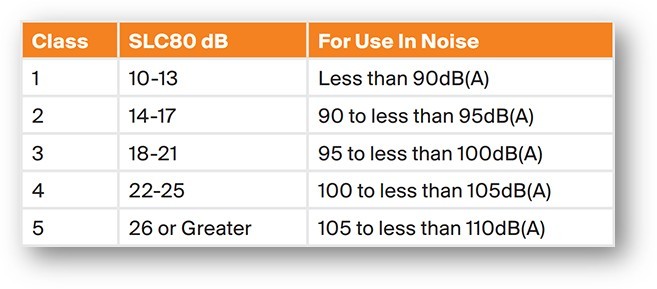
PCBUs must provide PPE that is:
- suitable for the nature of work and hazard, such as earmuffs and earplugs
- comfortable to wear, and of a suitable size and fit
- maintained, repaired or replaced when required
- used or worn by workers who have been trained in its use and care.
Ensure all workers are trained and instructed in fitting and wearing the hearing PPE
Involve your workers in the hearing PPE selection process and offer a reasonable choice from a range of types. Where necessary, obtain professional advice when selecting.
Do not provide hearing PPE that under-protects or over-protects a worker’s hearing
It is important that all hearing PPE has the appropriate protection rating.
There are dangers of workers being under-protected, however providing hearing PPE that over-protects a worker (ie: the hearing PPE is rated higher than the protection level determined by the workplace noise assessment) cuts out too much sound and may cause workers to experience disadvantages, such as:
- difficulty in communication, in hearing verbal instructions – even warning signals
- feelings of isolation, and
- discomfort, e.g.: heavy-duty earmuffs are heavier to wear and have a higher clamping force on the head
Protect your hearing
If you are required to wear hearing protection (PPE) in your line of work, then it’s important that you wear it correctly and consistently whenever you are exposed to hazardous noise.
Ask your employer or safety officer for guidance on the type and class of hearing protection that is right for you and your work environment.
Look out for hearing protection signage in your workplace: hearing protection should be used whenever you are in a signposted area.
Your employer will work with you to ensure your PPE is:
- Fit for purpose
- Comfortable and easy to use
- Clean and well maintained
- Enables you to still hear instructions and warning sounds
To get the full protection of hearing PPE workers must ALWAYS wear their PPE whenever they are exposed to hazardous noise during their work shift.
If the hearing PPE is removed, even for a short time, the protection provided to the worker will be substantially reduced.
Audio headphones (i.e. Apple AirPods and other personal music devices) must never be used as a substitute for approved hearing PPE. They are not designed to provide hearing protection and add to the level of outside noise, which can contribute to noise induced hearing loss.
If you are regularly required to wear hearing protection as a control measure for noise, your employer must ensure you undertake a hearing test. Your employer is responsible for paying for the hearing test.
For new workers, a baseline hearing test must be completed within three months of commencing your employment. You will then need to get a follow-up monitoring hearing test at least every two years during your employment.
Ensure you understand how to fit your PPE correctly, check out these resources to help you understand more about fitting PPE appropriately.
Earmuffs vs Earplugs - How do I find the right hearing protection?
Further links: